EMT Practice Test

1. Question Content...


Question List

Question1: An API client calls one method from an existing API implementation. The API implementation is later updated. What change to the API implementation would require the API client's invocation logic to also be updated?

Question2: How are an API implementation, API client, and API consumer combined to invoke and process an API?

Question3: Mule applications that implement a number of REST APIs are deployed to their own subnet that is inaccessible from outside the organization.
External business-partners need to access these APIs, which are only allowed to be invoked from a separate subnet dedicated to partners - called Partner-subnet. This subnet is accessible from the public internet, which allows these external partners to reach it.
Anypoint Platform and Mule runtimes are already deployed in Partner-subnet. These Mule runtimes can already access the APIs.
What is the most resource-efficient solution to comply with these requirements, while having the least impact on other applications that are currently using the APIs?

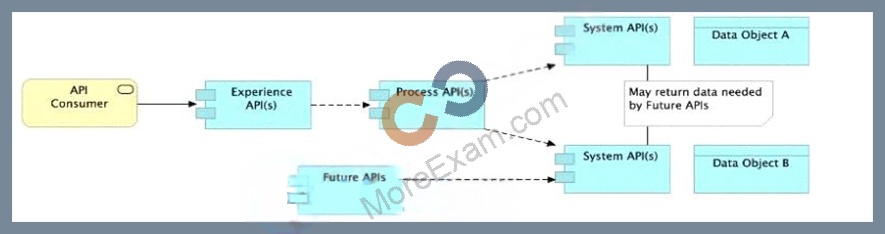
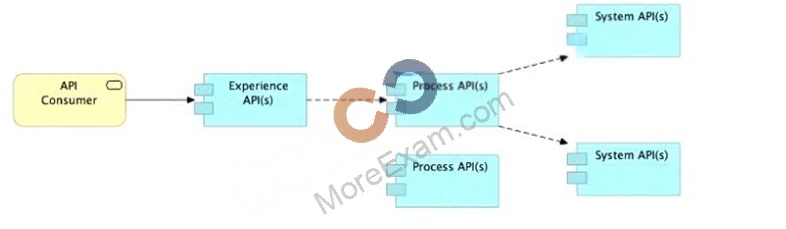
Question4: Refer to the exhibit.

What is the best way to decompose one end-to-end business process into a collaboration of Experience, Process, and System APIs?
A) Handle customizations for the end-user application at the Process API level rather than the Experience API level

B) Allow System APIs to return data that is NOT currently required by the identified Process or Experience APIs

C) Always use a tiered approach by creating exactly one API for each of the 3 layers (Experience, Process and System APIs)

D) Use a Process API to orchestrate calls to multiple System APIs, but NOT to other Process APIs

Question5: A retail company with thousands of stores has an API to receive data about purchases and insert it into a single database. Each individual store sends a batch of purchase data to the API about every 30 minutes. The API implementation uses a database bulk insert command to submit all the purchase data to a database using a custom JDBC driver provided by a data analytics solution provider. The API implementation is deployed to a single CloudHub worker. The JDBC driver processes the data into a set of several temporary disk files on the CloudHub worker, and then the data is sent to an analytics engine using a proprietary protocol. This process usually takes less than a few minutes. Sometimes a request fails. In this case, the logs show a message from the JDBC driver indicating an out-of-file-space message. When the request is resubmitted, it is successful.
What is the best way to try to resolve this throughput issue?

Question6: Which of the following sequence is correct?

Question7: A set of tests must be performed prior to deploying API implementations to a staging environment. Due to data security and access restrictions, untested APIs cannot be granted access to the backend systems, so instead mocked data must be used for these tests. The amount of available mocked data and its contents is sufficient to entirely test the API implementations with no active connections to the backend systems. What type of tests should be used to incorporate this mocked data?

Question8: Once an API Implementation is ready and the API is registered on API Manager, who should request the access to the API on Anypoint Exchange?

Question9: A System API is designed to retrieve data from a backend system that has scalability challenges. What API policy can best safeguard the backend system?

Question10: An organization has created an API-led architecture that uses various API layers to integrate mobile clients with a backend system. The backend system consists of a number of specialized components and can be accessed via a REST API. The process and experience APIs share the same bounded-context model that is different from the backend data model. What additional canonical models, bounded-context models, or anti-corruption layers are best added to this architecture to help process data consumed from the backend system?

Question11: What Mule application deployment scenario requires using Anypoint Platform Private Cloud Edition or Anypoint Platform for Pivotal Cloud Foundry?

Question12: What API policy would be LEAST LIKELY used when designing an Experience API that is intended to work with a consumer mobile phone or tablet application?

Question13: What is most likely NOT a characteristic of an integration test for a REST API implementation?

Question14: What are the major benefits of MuleSoft proposed IT Operating Model?

Question15: What CANNOT be effectively enforced using an API policy in Anypoint Platform?

Question16: Question 10: Skipped
An API implementation returns three X-RateLimit-* HTTP response headers to a requesting API client. What type of information do these response headers indicate to the API client?

Question17: What correctly characterizes unit tests of Mule applications?

Question18: When using CloudHub with the Shared Load Balancer, what is managed EXCLUSIVELY by the API implementation (the Mule application) and NOT by Anypoint Platform?

Question19: An API implementation is updated. When must the RAML definition of the API also be updated?

Question20: What is typically NOT a function of the APIs created within the framework called API-led connectivity?

Question21: An organization makes a strategic decision to move towards an IT operating model that emphasizes consumption of reusable IT assets using modern APIs (as defined by MuleSoft).
What best describes each modern API in relation to this new IT operating model?

Question22: A system API is deployed to a primary environment as well as to a disaster recovery (DR) environment, with different DNS names in each environment. A process API is a client to the system API and is being rate limited by the system API, with different limits in each of the environments. The system API's DR environment provides only 20% of the rate limiting offered by the primary environment. What is the best API fault-tolerant invocation strategy to reduce overall errors in the process API, given these conditions and constraints?

Question23: An Anypoint Platform organization has been configured with an external identity provider (IdP) for identity management and client management. What credentials or token must be provided to Anypoint CLI to execute commands against the Anypoint Platform APIs?

Question24: When must an API implementation be deployed to an Anypoint VPC?
Question25: A system API has a guaranteed SLA of 100 ms per request. The system API is deployed to a primary environment as well as to a disaster recovery (DR) environment, with different DNS names in each environment. An upstream process API invokes the system API and the main goal of this process API is to respond to client requests in the least possible time. In what order should the system APIs be invoked, and what changes should be made in order to speed up the response time for requests from the process API?

Question26: Traffic is routed through an API proxy to an API implementation. The API proxy is managed by API Manager and the API implementation is deployed to a CloudHub VPC using Runtime Manager. API policies have been applied to this API. In this deployment scenario, at what point are the API policies enforced on incoming API client requests?

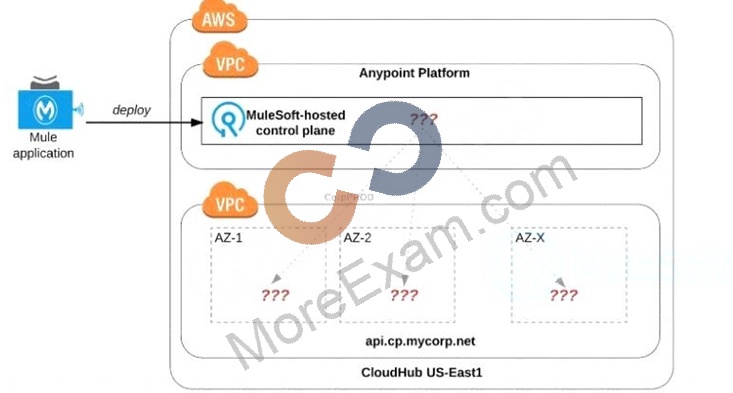
Question27: Refer to the exhibit.

An organization uses one specific CloudHub (AWS) region for all CloudHub deployments.
How are CloudHub workers assigned to availability zones (AZs) when the organization's Mule applications are deployed to CloudHub in that region?